Nexus Flooring Pre-Install Playbook
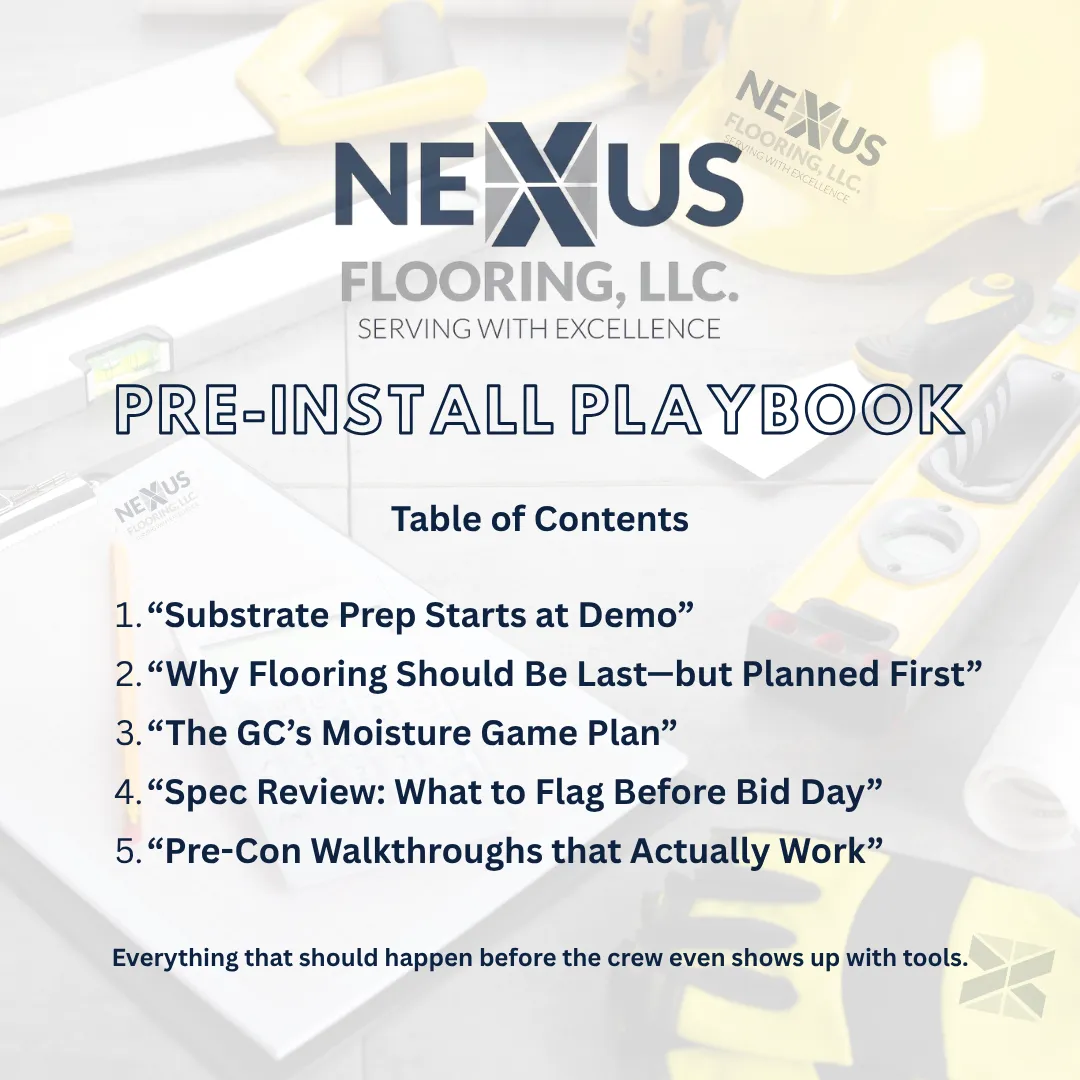
Everything that should happen before the crew even shows up with tools.
This series makes GCs look smart and saves them headaches by focusing on the planning layer where most flooring/tile problems originate.
Issues under this theme: Table of Contents
“Substrate Prep Starts at Demo” – What gets missed in the rush to clear space (and how it costs everyone).
“Why Flooring Should Be Last—but Planned First” – How sequencing errors create last-minute chaos.
“The GC’s Moisture Game Plan” – Testing timelines, HVAC startup, and who owns the prep.
“Spec Review: What to Flag Before Bid Day” – What’s hiding in the drawings that affects price and install.
“Pre-Con Walkthroughs that Actually Work” – What to look for when walking the job with your flooring partner.
"🔨 Substrate Prep Starts at Demo"
Because Your Floor Is Only as Good as What’s Under It
Let’s talk about the moment everyone forgets: demo.
Specifically, what's left after demo that turns your beautiful install plan into a field-condition mess.
We’re not blaming demo crews—they’re on tight timelines, just like everyone else. But if nobody’s watching the substrate during that phase, the flooring crew will pay the price. And by "flooring crew," we mean you.
🏗️ Demo Isn’t Done Until the Slab Is Ready
We’ve walked onto too many jobs with “demo complete” scopes that included:
Chipped, cracked, or spalled concrete
Old adhesive still clinging like a bad tattoo
Gypcrete that looks like oatmeal
Holes left behind by removed partitions, toilets, or mystery equipment
Unleveled transitions between rooms, pads, or old tile zones
And guess what? All of that needs fixing before the install starts. Which means time. And money. And sometimes—yep—a change order.
🔍 What We Watch For During Demo
At Nexus, we plan for demo like it’s part of the flooring install, because it is. We:
Review slab condition before and after demo
Flag risky areas in advance—plumbing chases, trench patches, entry transitions
Coordinate with GC teams to ensure patches, self-level, or skim coats are done before our mobilization
Clarify who owns what in writing, so there's no finger-pointing later
This isn’t about blame. It’s about buildable surface standards.
⚠️ Why This Matters to GCs
Your flooring install budget doesn’t include slab repair unless it’s clearly scoped
Installers aren’t magicians—they can’t lay over a broken base
Manufacturer warranties require specific prep conditions. If we install over junk, nobody’s covered.
Proactive planning today beats a painful punch list battle later.
✅ Nexus = Substrate Partner, Not Just Flooring Sub
We show up with:
Trained field teams who inspect substrate before install
Photos + documentation of existing conditions
Options for patch, skim, or prep if it’s needed (and clear quotes to back it up)
A clear understanding of what the job needs—not just what the drawings say
📬 Next in The Pre-Install Playbook:
“Why Flooring Should Be Last—But Planned First”
Let’s talk sequencing, stacking trades, and how flooring ends up being the most rushed part of the job (and how to fix that).
"Why Flooring Should Be Last—But Planned First"
Because Finishing Strong Starts Early
Flooring is always last.
Last trade in. Last in the schedule. Last to walk the job.
And often? The last thing anyone actually plans for.
That’s how you get “fire drill Fridays” where everyone’s scrambling to make space for install—while doors are being hung, millwork is arriving, and someone’s still painting baseboards.
Flooring isn't difficult. It’s that nobody gave it room to succeed. And that’s where we come in.
🔁 Flooring Is Last for a Reason
It protects the finish. It avoids rework. It looks clean and polished when the owner walks through.
But for it to go in smoothly, fast, and right, you have to:
Coordinate with other trades to not crowd us out
Sequence moisture testing and substrate prep early
Lock in material specs and submittals well before delivery
Allow drying, cure time, and acclimation before install starts
And yes, that means thinking about flooring way earlier than most schedules do.
📅 How Early Planning Saves Late Panic
We’ve helped GCs avoid last-minute chaos by planning for:
HVAC activation well before install (moisture + warranty protection)
Proper staging space for flooring materials in multi-phase jobs
Baseboard install after flooring (not during)
Coordinating with paint crews, electricians, and door/hardware teams to avoid footprint wars
If the site isn’t ready, the floor won’t be either. But that’s avoidable with a little foresight.
🧠 The GC’s Secret Weapon: Flooring Pre-Planning
Here’s what we do on projects where flooring is respected in the schedule:
Attend early coordination meetings or pre-con walkthroughs
Help flag sequencing conflicts (millwork, base, moisture cure)
Provide lead time estimates and stocking alerts
Offer install strategies that save time and money
That’s not just installing—that’s strategic partnership.
🛠️ Common Flooring Sins We See on Rushed Jobs
Material shows up before the jobsite is secured
Flooring crews laying around waiting on painters or drywallers to finish
Adhesives applied in unconditioned spaces
Wet-set tile over dusty, unprepped floors
Every one of these creates callbacks, change orders, or delays. None of them have to happen.
📬 Next in The Pre-Install Playbook:
“The GC’s Moisture Game Plan” – How to beat moisture issues before they become budget killers, and what we look for to keep your warranty intact.
“The GC’s Moisture Game Plan”
Because the Floor Doesn’t Care That You’re Behind Schedule
Slab moisture is like the weather:
You can’t control it—but if you ignore it, it’s going to ruin your day.
And your flooring.
And your warranty.
The truth is, moisture issues are one of the top causes of floor failure—and most of them can be avoided with a solid plan. But that plan needs to start before we show up with glue buckets and trowels.
💦 Moisture Doesn’t Care About Your Timeline
We get it—you’ve got a building to turn over. But flooring adhesives, underlayments, and tile systems don’t flex just because someone moved up the date.
Here’s what needs to happen:
HVAC must be running and conditioned per spec
Moisture testing (RH, calcium chloride) must be complete and documented
If mitigation is required, it has to be approved, scheduled, and cured before install
Skipping this? That’s like skipping rebar in your slab—sooner or later, it’ll break.
🧪 What the Moisture Game Plan Looks Like
At Nexus, we help build a proactive moisture plan with:
Manufacturer-aligned testing procedures (and timing)
Slab condition monitoring during phases
Backup mitigation options—priced and ready if levels come back too high
Clear communication about when flooring can be installed (and when it can’t)
Because if the test says wait—and you go anyway—you’re on your own with the warranty.
📉 Moisture Problems We’ve Helped GCs Avoid
LVT cupping and seam failure due to unconditioned slabs
Tile cracking due to vapor pressure movement
Adhesive bubbling under sheet goods in high-RH spaces
Failed inspections due to incomplete moisture documentation
Every one of these had a warning sign. We helped catch it.
🛠️ How GCs Can Win This Battle
Plan moisture testing into the schedule (not as a surprise)
Don’t assume “dry” = dry enough
Ask for help early—we’ve got the field-tested tools and data
Don’t sign off on installs if HVAC and moisture aren’t in place
We’re not being difficult—we’re protecting your floor, your warranty, and your reputation.
📬 Coming Soon in The Pre-Install Playbook:
“Spec Review: What to Flag Before Bid Day” – How to catch the landmines hiding in tile/flooring specs before they explode on your budget.

“Spec Review: What to Flag Before Bid Day”
Because “We Thought That Was Included” Is Not a Strategy
Flooring and tile specs can be deceptively simple—until the install starts and the RFIs start flying.
We've seen it too many times:
Vague materials
Missing transition details
No mention of substrate requirements
Moisture expectations left to interpretation
And the worst part? These things don’t usually get caught until after the budget is locked in and the GC is trying to protect their margin.
That’s why we say: Review the specs early. Ask the right questions. And let us help you read between the lines.
📄 What to Watch for in the Spec Book
Before you send out flooring for bid, take a look at:
✅ Substrate expectations — Is floor prep included? How much?
✅ Transition details — Are they specified? Or just “match existing”?
✅ Moisture mitigation responsibility — Who’s testing? Who’s fixing?
✅ Base material and height — Rubber? Tile? Coved? Flat?
✅ Product equal language — “Or equal” to what, exactly?
Even small gaps here can create major confusion—and change orders—down the road.
🧠 How Nexus Helps You Win Before Bid Day
We review tile and flooring scopes with your estimator or PM before you commit. We’ll help you:
Identify vague or risky language
Spot spec gaps that will become budget busters
Suggest product or system clarifications that avoid rework
Propose smart VE options before they’re driven by cost pressure
And yes—we’ll give you notes to bring back to the design team or owner with diplomacy.
💬 GCs We've Helped Mid-Spec Say...
“If we’d priced it like the spec said, we’d have lost money on the prep alone.”
“You helped us win the job and not eat the schedule in Phase 2.”
“We didn’t know what we didn’t know. Thanks for calling it out early.”
🚧 This Is the Real Pre-Install Work
By the time crews are on site, it’s often too late to fix scope gaps.
But if you call us before you price it, we’ll help you:
Protect your margin
Eliminate surprises
Build a smoother install plan
It’s not just product knowledge. It’s project foresight.
📬 Last in The Pre-Install Playbook:
“Pre-Con Walkthroughs That Actually Work” – What to look for, what to ask, and how Nexus helps catch the problems that don’t show up on drawings.
“Pre-Con Walkthroughs That Actually Work”
Because You Don’t Want to Discover Problems With a Trowel in Hand
We love a good pre-con meeting.
But let’s be real: most of them feel like checkbox exercises.
Everyone signs in, someone reads the schedule, and the last trades to install—like flooring—get five minutes at the end.
Here’s the problem: everything you ignore on a walkthrough shows up on the punch list. Or worse, in a change order you weren’t planning for.
That’s why we treat the flooring/tile pre-con as mission-critical. And why GCs who walk the job with us tend to finish stronger.
👀 What a Real Flooring Pre-Con Looks Like
You don’t need a deep dive on adhesive chemistry—you just need to:
Walk every room where flooring/tile is going down
Review where and how products transition (especially in mixed-surface projects)
Confirm base height/material vs. flooring thickness
Verify patch/skim prep responsibility
Ask: “Has the substrate been tested, patched, and cleared?”
Look at traffic routes for carts, gear, and cleanup access
It’s not hard—but skipping it makes everything harder.
🧠 What Nexus Does on Every Walk
When we walk your job, we’re not just “checking boxes.” We:
Inspect substrates for cracks, glue residue, and moisture red flags
Review layout for tricky transitions or phasing conflicts
Confirm material storage and staging access
Coordinate with other trades that affect install (paint, millwork, etc.)
Flag missing info before it delays us—or you
We’re not nitpicking. We’re protecting your timeline.
🛑 Top Issues We Catch in Pre-Cons
No moisture test results on file
Wrong base type ordered for the flooring spec
Door swings that conflict with flooring direction
Flooring areas blocked by scaffold or construction debris
HVAC off—or not scheduled to run during install
None of these are major—until they aren’t.
💬 A Super Once Told Us:
“You guys caught more in 20 minutes than our whole walkthrough team did all week.”
That’s the goal. One walkthrough. Fewer surprises. A cleaner closeout.
🎯 Final Thought:
A great install starts with good communication and clear conditions. Walk the job with us early, and we’ll help you:
Prevent problems
Protect your schedule
Look like a genius at turnover
That’s what we mean when we say: Service with Excellence.


Schedule Free Proposal Consultation
Review Nexus Pre-Install Playlist
Read The Nexus Insider Round Two